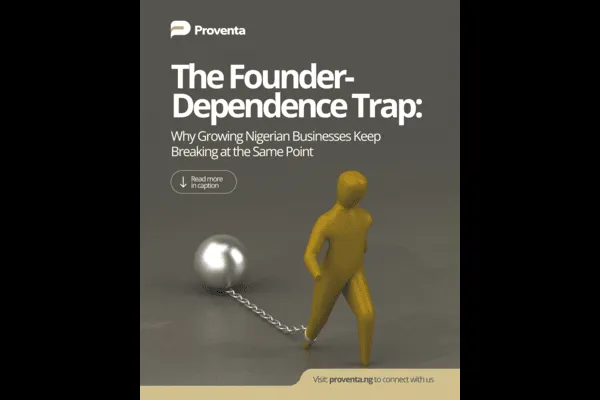
The Founder-Dependence Trap: Why Growing Nigerian Businesses Keep Breaking at the Same Point
There is a particular stage in the life of a Nigerian business that looks like success from the outside but can feel like a crisis from inside.
The business has survived its early years. Customers are coming. Revenue is growing. More people have been hired. Perhaps there is a second branch, a bigger office, a new product line or plans to enter another market. Yet the founder is more exhausted than ever.
Every important decision still comes to the founder. Staff wait for approval before moving. Customers insist on speaking to the owner. The finance team needs the founder to authorise payments. Managers escalate routine problems. The founder is copied on almost every important email. That means the business has grown, but the organisation has not grown with it. It is what I call the founder-dependence trap.
It is an especially important issue in Nigeria because so much of our private sector is built around entrepreneurial ownership. According to data from the NBS and SMEDAN cited by PwC, micro, small and medium enterprises accounted for 96.9% of businesses and 87.9% of employment in Nigeria in the 2021 MSME survey, while contributing 46.32% of GDP. These businesses are not peripheral to the Nigerian economy. They are the economy in which millions of people work every day.
The question, therefore, is not whether founders should remain central to their businesses. It is whether businesses can successfully transition from being dependent on a founder's personal capacity to being supported by systems, people and structures that can carry the founder's ambition.
The problem often begins as a strength
Founder dependence is not created by incompetence. In fact, it is often the consequence of doing things very well at the beginning.
When a business is small, the founder may reasonably know almost everything. They know the customers personally. They know which supplier to call. They know which employee can solve a particular problem. They understand the numbers, the product and the market.
Decisions can be made in minutes because the person with the context is sitting in the room, but growth changes the mathematics.
A founder who could personally supervise five employees cannot indefinitely supervise 50. A founder who could approve every expense cannot remain the final authority for every transaction as the organisation becomes more complex. The informal knowledge that once made the business agile can eventually become a bottleneck.
This is where some Nigerian businesses struggle. They increase the size of the business without changing the structure of the organisation. They add people without redesigning roles. They add branches without strengthening reporting systems. They increase sales without improving management information. They appoint managers without giving them meaningful authority.
The result is an organisation that is larger, but not necessarily more institutional.
The founder becomes the operating system
One of the clearest signs of founder dependence is that the founder becomes the business's operating system. If the founder is absent, things slow down. If they are busy, decisions wait. If they change their mind, priorities change. If they do not remember a process, nobody else is entirely sure what to do. This can be difficult to see because the business may still appear functional.
A business is not truly scalable simply because it can sell more. It must also be able to make decisions, execute processes, manage people and maintain standards at a greater scale.
Research on management practices reinforces this point. World Bank research involving small firms across several developing countries, including Nigeria, found that stronger business practices are associated with better productivity, sales and profits, while firms with stronger practices are also more likely to survive and grow.
In other words, structure is not bureaucracy for bureaucracy's sake. Good management practices can become an economic advantage.
The mature business is not one where the founder does less simply because they are tired. It is one where the organisation itself becomes stronger.
The founder should be able to spend more time thinking about direction, capital allocation, strategic relationships, market opportunities and long-term positioning because the organisation has developed the capacity to handle more of the operational load. That transition requires deliberate work.
It may involve redesigning roles and reporting lines. It may require clearer governance, better management information, documented processes or stronger performance systems. In some businesses, it may begin with something as basic as establishing who has authority to make which decisions.
The important point is that growth should eventually move beyond the founder's personal capacity.
Nigeria does not have a shortage of ambitious entrepreneurs. We have businesses that have demonstrated remarkable resilience under difficult conditions. The next challenge is building institutions that are as resilient as the people who started them.
Building a business strong enough to carry the vision without requiring the founder to carry everything, should be the founder’s greatest contribution to the business.
This is the thinking behind Proventa Global Business Services. Through Business Diagnostics, Corporate Restructuring and Management Advisory, Proventa works with founders and management teams to see the business clearly, strengthen its foundation and make better decisions for the road ahead. Because sustainable growth is not simply about making the business bigger, it is about making the business stronger.
